Reformer Pilates for Beginners: Everything You Need to Know
- 6 days ago
- 7 min read
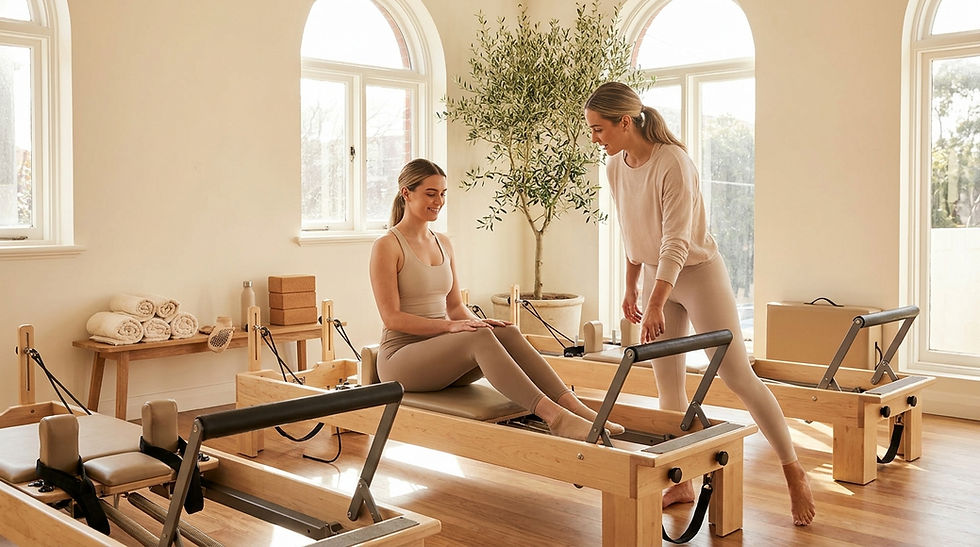
The Reformer can look intimidating at first. Straps, springs, a carriage that slides back and forth on a long wooden frame. If you've never used one, it can read more like a piece of factory equipment than a fitness tool.
In reality, the Reformer is one of the most accessible and effective ways to build strength, mobility and body awareness, particularly if you're new to movement or coming back to it. Every week, people walk into BodyMindLife Bondi having never touched a Reformer in their lives. By the end of their first class they're moving with confidence and already thinking about when they'll be back.
This guide walks you through what the Reformer actually is, how it works, what happens in your first class, and why the machine is your biggest asset as a beginner. No experience required.
What Is a Reformer Pilates Machine?
The Reformer looks a little like a bed mounted on a low frame. At its centre is a sliding platform called the carriage, attached to a set of springs. You sit, lie or kneel on the carriage, and the springs create resistance as you move it back and forth.
That's the simple version. The clever part is that the same machine adapts to almost every body and every level. You change the resistance by adding or removing springs, by where you position yourself on the carriage, and by the speed at which you move. The same class can challenge a complete beginner and a long-time practitioner side by side, with each working at the level that suits them.
A Reformer has a few key parts.
The carriage is the sliding platform you'll spend most of class on. As you press or pull against resistance, it glides smoothly back and forth.
The springs create the resistance. More springs, more challenge. Fewer springs, less. Beginners usually work with one or two springs for most movements.
The footbar is a padded bar at one end of the machine that you press through with your feet for many of the foundational movements.
The straps attach to the springs and give you something to push or pull against with your hands or feet.
The shoulder rests and headrest keep you stable and supported when you're working from your back.
At BodyMindLife Bondi, we use Allegro 2 Reformers across both Pilates studios. They're considered the industry standard for a reason. Smooth carriage glide, reliable spring tension, and built for the kind of precise, controlled movement Pilates is known for.
How Spring Resistance Works (And Why It's Brilliant for Beginners)
Here's where the Reformer becomes your secret weapon.
Free weights are binary. A 5 kg dumbbell is 5 kg from start to finish. Pilates springs are different. The further you stretch a spring, the more resistance it gives back. So if you're pressing the carriage away from the footbar, the resistance increases as you extend, and eases as you return.
That variable resistance is biomechanically intelligent. It's gentle where you're weakest (at the start and end of a movement) and challenging where you're strongest (through the middle range). You're not fighting a fixed weight. You're working with a force that scales to your own capability.
For beginners, that means you can dial intensity up or down by:
Adding or removing springs before a movement
Adjusting your position on the carriage
Slowing down (slower movement means more time under tension, which is harder)
You're never stuck at a level that doesn't suit you. The machine meets you where you are.
What to Expect in Your First Class: Essentials Reformer
Essentials Reformer runs every day at BodyMindLife Bondi and is designed for people new to the practice. The studio opens 15 minutes before class, so you'll have time to settle in, meet your teacher and get set up without rushing.
When you arrive, tell your teacher it's your first class. They'll walk you through the basics, help you set up your machine, and quietly tailor their cues throughout the class so you can follow along without feeling lost.
The class itself is 50 minutes. Your teacher will guide you through a sequence of movements designed to introduce you to the Reformer, build foundational strength and core stability, and leave you feeling lengthened and connected by the end. Every movement scales to your level by adjusting springs and position, so you'll work at an intensity that suits your body on the day.
You'll likely walk out feeling taller, calmer and more aware of your body than when you walked in.
What to Wear and Bring
Reformer Pilates is best done in form-fitting clothes so your teacher can clearly see your alignment. Loose layers hide what your body is doing.
The essentials are simple. Form-fitting leggings or shorts. A fitted top or singlet. Grip socks, which are non-negotiable for Reformer classes because your feet grip the footbar, straps and carriage throughout class. If you don't have a pair, you can buy them at reception.
Bring a water bottle. Towels are provided. A hair tie if your hair is long. You don't need a mat, blocks or any other equipment.
What the Movements Will Feel Like
Pilates language can sound a bit mysterious before you've experienced it. Here's what you can actually expect to feel.
Foot and leg work. Most beginner classes start with the lower body. You'll feel your legs working in unfamiliar ways, and you'll usually notice your inner thighs, glutes and deep core lighting up. This is your body remembering muscles it doesn't use often.
Core engagement. Almost every movement on the Reformer requires the deep core to switch on. Beginners often describe this as feeling like the body is suddenly more connected, with the trunk doing work it didn't realise it was supposed to.
Arm and shoulder work. When the straps come into play, your back, shoulders and arms join the conversation. The work is precise and controlled rather than explosive, which is why even experienced gym-goers often find Reformer classes surprisingly demanding.
Full-body integration. By the second half of class, most movements ask several muscle groups to coordinate at once. This is where the mind-body connection really starts to click.
You don't need to know the names of any of this in advance. Your teacher will guide every movement clearly, and your body will start picking up the patterns within a class or two.
Why Beginners Thrive on the Reformer
Three reasons the Reformer is one of the most beginner-friendly tools in fitness.
Low impact, supportive movement. The machine supports your body and removes the impact of floor-based or weight-based training. That makes the Reformer ideal if you're returning from injury, managing joint pain or simply want to build strength without grinding the body down. Mention any injuries to your teacher before class so they can guide modifications.
Immediate feedback. Spring resistance gives your body instant information about what's working and what isn't. The mind-body connection that takes months to build elsewhere often starts to come online in your first class.
Effortlessly scalable. Everyone in the class can be working at a different level on the same machine. You're never holding the room back, and you're never being pushed beyond what your body can do that day.
Getting Started at BodyMindLife Bondi
BodyMindLife Bondi has two boutique Pilates studios and a daily schedule built so you can find a class that fits your week.
If you're new, start with Essentials Reformer. It runs every day and is designed for first-timers and returning beginners. You can drop in for a single class at $45, or, the option most beginners choose, start with our 21 Day Trial. $99 for 21 days of unlimited yoga and Reformer Pilates. It removes the decision fatigue of booking one class at a time, and it gives you long enough to feel real changes in your body.
Your teachers are part of what makes the Bondi studio what it is. BML has a wide team of experienced Pilates teachers who are exceptional with beginners. You can read their bios on the teachers page.
As you grow into the practice, you'll find your way into Flow Reformer (all levels) and eventually Progressive Reformer (advanced, three times a week).
Frequently Asked Questions
Will I be sore after my first class? Probably a little. Reformer Pilates recruits muscles in new ways, so legs, glutes and deep core often feel awake the next day. The soreness is usually mild after Essentials classes and passes within a few days as your body adapts.
Is Reformer Pilates suitable if I have back pain? Many people use Reformer Pilates to strengthen the core and stabilise the spine, which can help with back pain over time. If you have acute pain or a diagnosed condition, mention it to your teacher before class so they can guide modifications.
Can I do Reformer Pilates if I'm pregnant? Yes, with some care. Essentials Reformer is suitable throughout pregnancy. Flow Reformer is suitable up to around 20 weeks. Progressive Reformer is not suitable during pregnancy. Always let your teacher know you're pregnant before class.
How often should a beginner do Reformer Pilates? Two to three classes a week is the sweet spot. It gives your body time to adapt while building real momentum. Consistency matters more than frequency, especially in the first few weeks.
What if I've done yoga but never Pilates? You'll have a head start in body awareness and breath control. Reformer Pilates will still feel new because of the resistance and the precision the machine asks for. Most yoga practitioners love it as a strength-building complement to their practice.
Do I need a base level of fitness to start? No. Essentials Reformer is genuinely beginner-friendly, and the spring system means the work scales to whatever level you're at on the day. Showing up is the only requirement.
Your First Week
The Reformer stops being mysterious the moment you step onto it. It's a tool that responds to you, and your first week is simply about learning the feedback it gives and how your body likes to move.
Go in with simple expectations. Arrive a little early. Tell your teacher it's your first class. Use the springs they suggest. Breathe. That's the whole assignment.
Book your first class at bondi.bodymindlife.com or visit us at 40 Hall Street, Bondi Beach. You'll walk out stronger, more aware, and already thinking about your next class.