Is Reformer Pilates Hard for Beginners? (What If You Feel Too Weak)
- 10 hours ago
- 6 min read

TL;DR: Reformer pilates is not hard for beginners in the way most people fear. You do not need to be fit, strong or coordinated to start, because the springs assist your movement and a good teacher sets the resistance to you. The early difficulty is coordination, not fitness, and it usually settles within four or five classes. The trick is starting in a beginner-specific class, not an all-levels one.
If you have watched a reformer class through the studio window and thought "I would be the weakest person in there," you are not alone, and you are also wrong. We have started thousands of complete beginners on the reformers at our Bondi studio since 2002, and almost every one of them walked in sure they were too unfit, too weak or too uncoordinated to keep up. One beginner summed up the feeling on Reddit: "I just wanna be a pilates girlie but this is making me want to give up." Here is the honest answer to whether reformer pilates is hard for beginners, and what to do if you feel too weak.
Is reformer pilates hard for beginners?
It can feel awkward at first, but it is not hard in the way you are picturing. The early challenge is coordination, learning to move with the carriage and the springs, rather than raw fitness or strength. That coordination clicks for most people within four or five classes. Because the resistance is fully adjustable, you are never asked to do more than your body can manage on the day, which is the opposite of how an intimidating-looking machine appears from the outside.
Do you need to be fit or strong to start reformer pilates?
No. You do not need to be fit, strong, flexible or coordinated before your first class. The reformer exists to build those things, not to demand them. Its spring system can actually assist a movement your muscles could not yet do on their own, which is why many people find reformer more accessible than mat pilates, not less.
The research backs this up for exactly the people who feel most unsure. A 2025 randomised controlled trial published in Scientific Reports found that two to three reformer sessions a week improved body composition, muscle strength and endurance, and reduced anxiety in overweight and obese women, a group routinely told they are not fit enough to start. If it works from that starting point, it works from yours.
Why do you feel weak and shaky in the first few classes?
That trembling, can't-quite-hold-it feeling is normal, and it is not a sign you are failing. Reformer pilates targets small stabilising muscles that most training ignores, so they fatigue quickly and shake while they learn the job. The burn you feel is those muscles waking up, not proof that you are unfit.
Medical News Today describes reformer pilates as a low-impact method suited to a wide range of fitness levels, precisely because the load is controlled and adjustable. So when a beginner admits, as one did, "I can't bear the burn and I'm stepping off every few moves," that is not weakness. That is week one. Stepping off to reset, dropping to a lighter spring, or sitting an exercise out is completely normal, and everyone in that room did the same in their first month.
"I can't keep up": what to actually do in class
If you feel you cannot keep up, you have more options than you think, and using them is exactly what beginners are meant to do. The fear of falling behind is real, but the fix is simple and nobody is watching as closely as you imagine.
Tell the teacher you are new before class starts, so they keep an eye on you.
Drop to a lighter spring or take the easier variation whenever one is offered.
Rest when you need to, then rejoin at the next exercise.
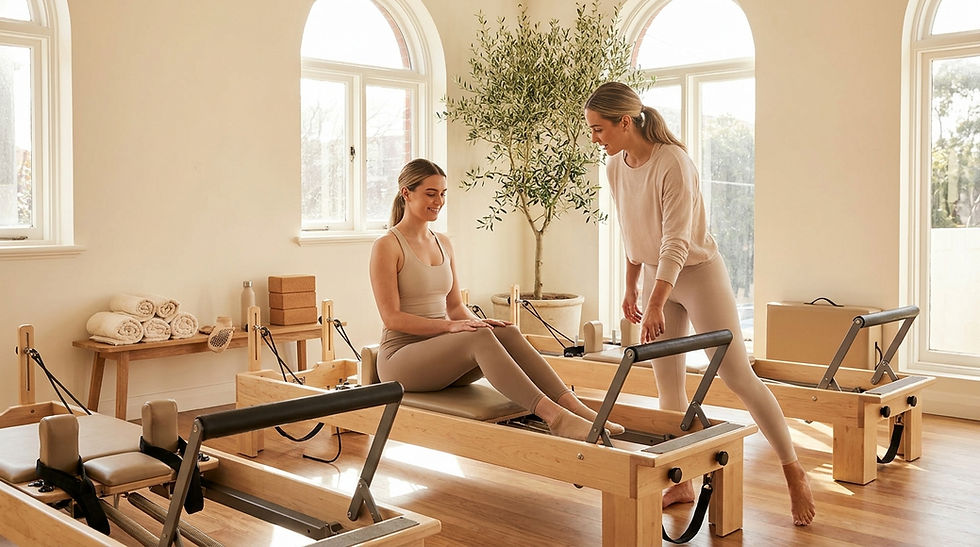
None of that is failing. A good instructor would far rather you move well at half the pace than push through with sloppy form. At our Bondi studio, the Essentials Reformer class is built around this, with beginners grouped together so the teacher can set your springs and correct your form instead of running an advanced flow.
Is reformer pilates harder than mat pilates?
For most beginners, the reformer is the easier place to start, not the harder one. Mat pilates relies entirely on your own body weight and core control, which is unforgiving when you are new. The reformer's springs give you support and feedback, holding you in position and guiding the movement so you can actually feel which muscles should be working. The machine looks intimidating, yet it is the very thing making the work more accessible. Plenty of people do both in time, but if you are nervous and new, the reformer is the kinder beginning.
How long until reformer pilates stops feeling hard?
Most beginners feel noticeably more coordinated by their fourth or fifth class, and the awkward where-do-my-hands-go phase passes fast. Around weeks three to four the work shifts from confusing to genuinely challenging in a good way, and most people notice real changes in posture, core control and how their body feels within four to six weeks of going two to three times a week. The difficulty never fully disappears, it simply moves, because the springs and the exercises scale up with you. That is the design, not a flaw.
How to start so it never feels too hard
Start in the right class and tell the right person you are new. Three things make almost all the difference for a nervous beginner:
Book a beginner or Essentials class, never an all-levels or advanced one. The pace and assumed knowledge in an open class are what leave beginners feeling lost.
Tell the teacher it is your first time. They will set your springs and watch your form from the start.
Go two to three times a week for the first few weeks. Consistency turns coordination from a struggle into second nature far quicker than one class a fortnight.
Do those three things and the "I'm too weak" feeling tends to fade by the second week, replaced by the quiet satisfaction of watching yourself improve.
Frequently asked questions
Can I do reformer pilates if I'm really unfit or overweight?
Yes. Reformer pilates is one of the safest low-impact ways to begin exercising from a low fitness base, because the springs support you and the resistance scales to your level. The 2025 Scientific Reports trial found overweight and obese women improved strength and body composition with two to three sessions a week. Tell your instructor your starting point and they will adjust each exercise to suit it.
Will I be the worst person in the class?
No, and the room is paying far less attention to you than you fear. Beginner classes are full of other beginners, and the teacher expects you to be new. Most people feel self-conscious for a class or two, then realise everyone is focused on their own springs.
Do I need to be strong to use the reformer?
No. The reformer builds strength rather than requiring it. Lighter springs make some exercises easier and others harder, so your instructor can match the load to what your muscles can do today, then progress you as you get stronger.
Is reformer pilates harder than mat pilates?
For most beginners the reformer is the easier place to start, because the springs assist and guide the movement instead of leaving you to hold everything with body weight alone. Mat pilates can actually demand more core control from your very first class.
How many classes until reformer pilates gets easier?
Coordination usually clicks around the fourth or fifth class. Expect it to feel awkward, then manageable, then satisfying. Going two to three times a week gets you there faster than going occasionally.
The honest bottom line
Feeling too weak is the most common reason people put off their first reformer class, and it is the worst reason, because the class is built for exactly that. The springs meet you where you are, the teacher adjusts the rest, and the only people who stay "too weak" are the ones who never start.
Come and start on the reformers at our Bondi studio with the 21-day unlimited trial. Book an Essentials Reformer class, tell the teacher you are new, and let the machine do what it was designed to do. Start your 21-day unlimited trial.