Your First Reformer Pilates Class: 9 Things to Expect
- Apr 27
- 8 min read

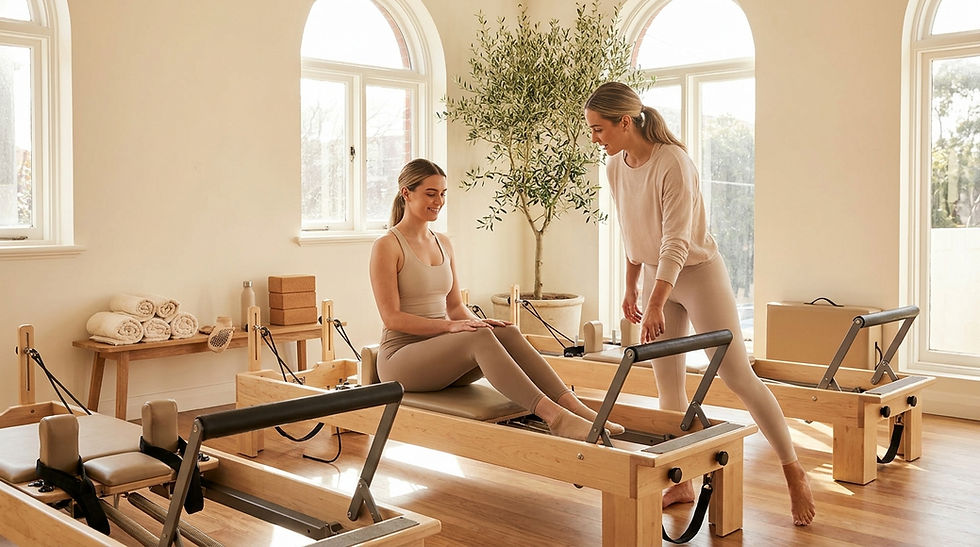
The Reformer is one of the most beautiful and intimidating pieces of fitness equipment you'll ever see. It looks like a bed crossed with a science experiment. There are springs, straps, a sliding carriage, and enough moving parts to make anyone pause. But here's what matters: it's far less complicated than it appears, and one well-taught class demystifies the entire machine.
If you're considering your first Reformer Pilates class at BML Bondi, this guide walks you through exactly what to expect. You'll understand the machine, know what to bring, understand how your teacher scales the workout to your level, and leave feeling confident rather than confused. BML has been teaching Reformer and yoga in Bondi since 2002, so we've welcomed thousands of first-timers through the door.
What Is This Machine, Anyway?
The Reformer is an ingenious piece of equipment invented by Joseph Pilates in the 1920s. It's roughly the size of a narrow bed with a platform called a carriage that slides back and forth along a frame.
The components work together in specific ways. The carriage sits on rails and moves smoothly on rollers. Springs attach the carriage to the frame. These springs provide resistance and support for movement. You adjust the resistance by adding or removing springs, typically ranging from zero springs to four springs depending on the exercise.
The footbar is adjustable and positioned at the end of the frame. It's where you place your feet for many exercises and helps stabilize your position. Shoulder rests prevent you from sliding off during certain movements. The straps attached to handles allow you to work your arms and legs in various directions.
This design is brilliant because it's infinitely customizable. By adjusting springs, changing body position, modifying where you anchor, and adding props like blocks or foam rollers, your teacher can scale any exercise from beginner-accessible to advanced-challenging. The same machine serves every fitness level safely.
The Spring System: Why It Matters
Springs might seem like a small detail, but they're crucial to understanding how Reformers work.
Springs provide two types of support. They add resistance when you move away from the frame (making work harder) and they assist when you move toward the frame (making work easier). This is different from free weights, which only provide resistance against gravity.
For your first class, your teacher will set the springs based on the specific exercise and your strength level. Usually for beginners, that means starting with lighter resistance (fewer springs) and gradually building to more challenging weights as you progress. You won't be left struggling or bored. The teacher watches and adjusts.
Understanding springs helps you understand why Reformer is so effective. Unlike most cardio machines that primarily work one direction, the Reformer engages your stabilizer muscles from every angle. You're building functional strength that translates to real-world movement.
What to Bring and Wear
Preparation removes anxiety. Here's the specific checklist for BML Bondi.
Bring a water bottle. You'll want to hydrate, especially in your first few classes when you're working hard.
Wear comfortable clothes that let you move freely. Typical options are yoga leggings and a tank top, or shorts and a sports bra. Avoid loose clothes that might get caught or create visibility issues. You'll be in various positions throughout class.
Most importantly, bring or purchase grip socks. BML requires grip socks for all Reformer classes. These are socks with grips on the bottom that prevent slipping on the machine's surface. They're essential for safety. You can grab a pair at BML's reception before your first class if you don't already own any.
Arrive 10-15 minutes early so you can chat with your teacher about any injuries, physical conditions, or concerns. This information helps them offer appropriate modifications and scale your experience safely.
The First Few Minutes: Setup and Orientation
Your teacher will greet you warmly and ask a few questions. Have you done Pilates before? Any injuries or physical limitations? This conversation is essential. Be honest. Your teacher wants to help you practice safely.
Next comes the orientation. Your teacher will walk you through the basic Reformer mechanics. They'll show you how the springs work, how to adjust the carriage position, and how to use the various attachments. This takes maybe five minutes and answers your biggest questions immediately.
Then the class begins, often with breathing exercises and light stretching on the Reformer to warm your spine. This isn't intense. It's the time your nervous system acclimates to the machine and you find your positioning.
The Essentials Reformer Class: What Your First Class Likely Looks Like
At BML, beginners typically start with Essentials Reformer, a 50-minute class designed specifically for people encountering the machine for the first time or building fundamental strength.
A typical Essentials class flows like this. You begin lying on your back on the carriage, springs set light to moderate. Your teacher introduces foot work, where you push the carriage away and pull it back using your feet. This warms your legs, hips, and core. Multiple variations exist, but you'll hold the foundation and let your teacher demo each variation.
Next comes seated spinal stretches and side stretches on the Reformer. You're building mobility while the springs support your movement.
From here, you might move to standing work. This is where the machine's magic becomes apparent. Standing exercises on an unstable carriage demand tremendous core and stabilizer engagement. You're balancing while moving a heavy load. Your entire body lights up. You're not just working your legs and glutes. Every micro-stabilizer is firing.
You'll flow through arm work, core exercises, and often some standing leg work. The class typically includes a progression where your teacher demonstrates the full movement, then offers modifications for different levels. You choose whether to try the full version or the modification. No judgment either way.
Class finishes with cool-down stretching and breathing work. Some teachers end with a guided relaxation or meditation. You leave feeling strong, capable, and already planning your next class.
The Soreness That Follows: Why Your Glutes Hurt Tomorrow
First Reformer Pilates classes often create soreness in unexpected places. Your glutes might be sore. Your core might be tight. Your outer hips might feel worked in a way they've never been worked.
This is completely normal. You're engaging muscles from angles you've never recruited before, even if you're fit or exercise regularly. This soreness (sometimes called DOMS, delayed onset muscle soreness) is a sign of adaptation. Your muscles grew slightly. Your nervous system formed new movement patterns. This soreness typically lasts 2-3 days and decreases significantly by your second class.
The key is to return for that second class. Movement helps resolve soreness faster than rest. By class two, you'll feel significantly less sore and significantly more confident.
How Your Teacher Scales the Machine for Your Level
One of Reformer's greatest features is its scalability. Your teacher isn't watching from a distance hoping everyone's okay. They're watching you specifically and adjusting your experience in real time.
If you're struggling, they'll reduce springs, simplify the movement, or add support. If you're finding it easy, they'll increase springs, remove support, or add challenge. This happens fluidly throughout class. You're never left feeling like you're failing or that you're not being challenged.
This scalability is why Reformer is uniquely beginner-friendly. No one's doing burpees while you're learning to step on a machine. Everyone's working at their edge, whether that edge is a light two-spring resistance or a full-springs challenging movement. As your confidence grows, you can progress into Flow Reformer and eventually Progressive Reformer for advanced work.
Class Sizes and Attention
At BML Bondi, our two boutique Reformer rooms are kept intentionally small. Class sizes stay tight enough that your teacher can actually see you, correct your alignment, offer modifications, and make sure you feel supported throughout the practice.
Compare this to a 30-person gym class where the instructor can't possibly see everyone. You get personalised attention while still being part of a community. You're not alone, but you're not invisible either.
Post-Class: That Feeling You'll Chase
Most people leave their first Reformer class feeling something they don't expect. Not exhaustion. Not pain. But a deep sense of having done something real. Your body feels worked. Your posture feels lifted. Your mind feels calm.
This is because Reformer demands full-body engagement and constant stabilization. You're not zoning out. You're present throughout. Your nervous system settles. Your core is engaged. Your proprioception improves. All of this creates a post-exercise glow that pure cardio sometimes misses.
This feeling is worth chasing. By class three, you'll recognize it and start looking forward to it. By class six, you'll notice your body has changed. By class twelve, you'll be amazed at what you can do.
Frequently Asked Questions
Q: Do I need to be fit to start Reformer Pilates? A: No. You need to be willing to move intentionally and listen to your body. Your teacher will scale every exercise to your current level. Deconditioned people often progress faster than fit people because they're not fighting their ego. They listen and adapt.
Q: Will Reformer Pilates make me bulky? A: No. Pilates builds long, lean muscle because the work is controlled and deliberate. You're not doing heavy powerlifting. You're doing challenging resistance work with high repetitions. This builds muscle endurance and tone, not bulk. You'll likely find your body getting more defined and sculpted over several weeks.
Q: Is Reformer as effective as gym training? A: Reformer is different from gym training, not better or worse. Gyms build strength through heavy loads. Reformer builds strength through precise movement patterns, stability, and mind-body connection. The most effective fitness combines both. Many BML students do weight training and add Reformer for core, stability, and recovery work.
Q: What if I fall off the machine? A: You won't. The carriage is designed so you can't fall off easily. You're either sitting, lying, or balanced carefully. Your teacher will show you exactly how to position yourself. The machine is stable and you're in control.
Q: How long until I see results? A: Many people notice postural improvements within two weeks. Visible muscle definition typically emerges by week four of consistent practice (2-3 classes per week). Real functional strength and confidence build over months. It's not overnight, but it's measurable.
Q: Can I do Reformer if I have a bad knee or back? A: Reformer can be adapted for most conditions, but always tell your teacher about any injuries. They can modify exercises to work around limitations while still strengthening supporting muscles. Some conditions benefit tremendously from Reformer. Others require extra care. Your teacher will know.
From Intimidated to Confident
That intimidating machine you're staring at in the studio window? You'll understand it fully within one class. By class three, you'll stop thinking about how the machine works and start thinking about how your body feels. By week four, you'll be the one looking completely at ease while newcomers stare wide-eyed.
The Reformer isn't complicated once you're on it. Your teacher handles all the details. You just show up, listen, and let your body do the work.
At BML Bondi, our Essentials Reformer class is designed exactly for this journey. You're not getting thrown into advanced work. You're building a solid foundation with attention and care. You'll leave your first class not just ready to return, but eager to book your second.
The machine's magic doesn't happen in that first class. It happens over weeks and months as your body adapts, your strength builds, and your confidence grows. That's why so many people walk into a Pilates studio once out of curiosity and keep coming back year after year.
Ready to Try Your First Class?
Our 21 day Trial gives you 21 days of unlimited Reformer Pilates and Yoga Classes just for $99. It's the easiest way to move past the Classes "intimidated by the machine" stage and into a real, sustainable practice.
Drop in any time at 40 Hall Street, Bondi Beach. Daily Reformer and Yoga classes, and a community that's been refining this practice in Bondi for over 20 years.