Yoga, Pilates & the Gym: Why You Don't Have to Choose
- May 8
- 8 min read

The fitness world loves a false choice. Either you're a yogi or a gym rat. Either you swear by the reformer or the squat rack. Either you believe in mindful movement or you lift heavy things.
This is nonsense. The strongest, most capable people don't pick. They stack.
And if you're not an elite athlete, the case for combining yoga, Pilates and gym work is even stronger. Your body is built to do many things. Lift. Run. Bend. Stretch. Stabilise. Climb. Recover. Move with awareness. Most of us only do one or two of these well, and then we wonder why we get injured, feel stiff, or plateau.
Here's what you need to know. Yoga, Pilates and gym work aren't competitors. They're complementary. Each addresses a different layer of physical capability, and combining them creates a resilient, capable body that's less likely to get injured and more likely to perform across the demands of a busy life.
Let's look at what each does best, and how to structure your week so they work together instead of against each other.
What the Gym Does Best: Build Strength and Muscle
The gym is exceptional at one thing. Progressive overload. You add a bit more weight or a few more reps, and your muscles adapt by getting stronger and bigger.
This has tangible benefits.
Metabolic advantage. Muscle tissue burns more calories at rest than fat tissue. The more muscle you have, the higher your metabolic rate and the easier it is to maintain a healthy weight.
Functional capacity. A strong body is more capable. You can carry groceries without your arms burning. You can play with your kids or grandkids without getting exhausted. You can recover from falls or injuries faster because you have reserve strength.
Bone density. Resistance training increases bone mineral density, which is crucial for preventing osteoporosis and fractures as you age.
Aesthetic changes. If you want visible muscle definition or to change your body shape, the gym is more direct than yoga or Pilates alone. It's not better or worse. It's just what it's built to do.
For most people, two to three gym sessions per week focused on resistance training is enough to build and maintain muscle. You don't need to live at the gym. You just need to be consistent and progressively challenge yourself.
What Pilates Does Best: Strength, Stability and Control
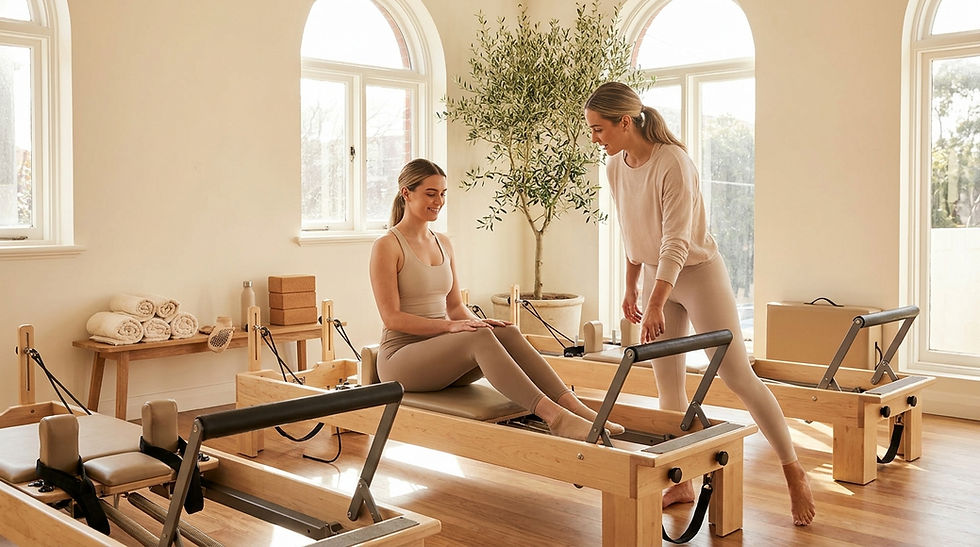
Here's where most people miss something important. Pilates, especially Reformer Pilates, is a strength-building practice. It just goes about it differently.
The Reformer uses springs to create resistance. That resistance is variable, scalable and surprisingly demanding. You can't muscle your way through it. You have to move with control, alignment and intention. The result is strength that translates directly into how you move through the world.
Core strength that actually means something. Most people think of "core" as abs. Pilates trains the deep stabilising muscles around your spine, pelvis and ribcage. This is the strength that protects your back, supports your posture, and makes every other movement (gym, yoga, walking, lifting your kids) more efficient.
Functional, full-body strength. A Reformer Pilates class works your legs, glutes, arms, shoulders and core in one session. You're building the kind of strength that shows up in real life. Better posture. Stronger lifts. More stable joints. Less back pain.
Joint-friendly progressive overload. Springs let you load the body with precision. You get the strength stimulus without the impact and joint stress that can come with heavy barbell work. This is why Reformer Pilates is popular with both elite athletes and people recovering from injury. It builds strength sustainably.
Postural correction. Most of us spend our days hunched at desks. Pilates lengthens the front of the body, strengthens the back, and rebalances the muscles that have gone to sleep. Within a few weeks of consistent practice, people stand taller and move more freely.
Mobility through strength. This is the magic of Pilates. You're not stretching passively. You're moving through full ranges of motion under control. That builds active mobility, which is more useful than passive flexibility because you can actually access it when you need it.
Mind-body connection. Like yoga, Pilates demands focus. You can't drift through a Reformer class. The precision required pulls you into the present and out of the noise of the day. People often leave a class feeling sharper, calmer, and more aware of how they're moving.
For most people, two to three Reformer Pilates sessions per week is enough to feel a meaningful shift in strength, posture and how the body moves. Pair that with one or two yoga sessions for recovery and you have a complete strength and mobility system.
What Yoga Does Best: Mobility, Recovery and Nervous System Regulation
Yoga addresses what the gym, and even Pilates, doesn't quite reach.
Deep mobility and flexibility. The gym builds strength through limited ranges of motion. Pilates builds active mobility through controlled ranges. Yoga goes further. It opens up the body in ways the other two don't, especially the hips, hamstrings, shoulders and spine. Over months, the gym can make you tight (especially the chest and front hips if you're at a desk all day). Yoga loosens you up.
Recovery. Intense training creates microscopic damage in your muscles, which is how they adapt and grow. But muscles need time to recover. Yoga, especially gentle and restorative styles, speeds up recovery by improving blood flow, lowering inflammation markers, and helping your nervous system shift out of fight-or-flight.
Nervous system regulation. The gym activates your sympathetic nervous system. The gas pedal. Pilates does too, although less aggressively. Yoga activates the parasympathetic nervous system. The brake pedal. It lowers cortisol, improves sleep, and creates the conditions for actual recovery. If you only ever press the gas, your body stays in a state of mild stress.
Injury prevention. Muscle imbalances and tightness are prime injury risks. Yoga addresses both. The body awareness you build in yoga makes you more attuned to subtle imbalances, so you catch them before they become injuries.
Sustainable movement. You can do yoga for your whole life. Many people practise into their 80s and feel great for it. Yoga is sustainably enjoyable, which matters more than any single training session.
The Real Difference: What Your Body Actually Needs
Think about what your body is designed to do. Humans are built to lift, but also to stretch and reach. To move hard and fast, but also to recover and move slowly. To build muscle, but also to maintain mobility. To be alert, but also to be calm.
One practice rarely covers all of this. So why are we still trying to choose?
A gym-only person ends up tight, stressed, and frustrated by their limited range of motion. A yoga-only person ends up soft, sometimes not as strong as they could be, and potentially short on the muscle mass that protects metabolism and bones. A Pilates-only person builds beautiful core strength and posture, but might not have the maximal strength of a gym goer or the deep flexibility of a dedicated yogi.
The person who layers all three becomes genuinely capable. Strong but mobile. Worked but recovered. Powerful but graceful. This is the kind of body that handles the unexpected demands of life with ease.
A Realistic Weekly Schedule That Works
If you're committed to combining all three, it doesn't require living at the studio. Two to three Pilates or gym sessions and two to four yoga sessions can be structured efficiently.
Here's a weekly example for someone who's moderately busy and wants strength, mobility and recovery in balance.
Monday: Reformer Pilates (50 minutes)
Tuesday: Yoga Flow (60 minutes)
Wednesday: Strength training at the gym, lower body focus (45 minutes) Thursday: Yin or Slow Flow Yoga (60 minutes, restorative focus)
Friday: Reformer Pilates (50 minutes)
Saturday: Yoga Flow or Essentials class (60 minutes)
Sunday: Rest or a gentle walk
This is around five hours of structured movement per week. It hits all the needs. Strength building through Pilates and the gym, deep mobility and recovery through yoga, and consistency you can sustain.
If you prefer a Pilates-led approach with less time at the gym, here's another version.
Monday: Reformer Pilates (50 minutes)
Tuesday: Yoga Flow (60 minutes)
Wednesday: Reformer Pilates (50 minutes)
Thursday: Strength training at the gym (45 minutes)
Friday: Reformer Pilates (50 minutes)
Saturday: Yoga (60 minutes)
Sunday: Rest
This gives you three Reformer sessions, two yoga sessions, and one gym session. You're building strength primarily through Pilates and using the gym for the heavier load work that complements it.
The key is that you're not choosing. You're layering. Each practice does what it does best.
On Functional Fitness and Bodyweight Training
You might be thinking, can't I just do yoga and bodyweight training? Isn't that enough?
Bodyweight training (push-ups, pull-ups, squats, planks) is excellent and often underrated.
You can build impressive functional strength without weights or machines.
But progressive overload with bodyweight hits a ceiling faster than with weights or springs. You can do 100 perfect push-ups, but at some point, adding load is more efficient for building strength. The gym and the Reformer both provide tools for that.
Yoga plus bodyweight is better than yoga alone. Yoga plus Pilates, or yoga plus intelligent strength training, is better still. The combination is what unlocks real, balanced capability.
Common Concerns About Combining Practices
Won't yoga or Pilates make me lose gains from the gym? No. Both practices support muscle building by improving recovery, mobility and movement quality. The concern usually comes from people who do too much volume with insufficient nutrition. That's a calorie problem, not a yoga or Pilates problem.
Do I need to do them on the same day? You can, but alternating days is often better. Heavy gym work followed immediately by deep yin yoga might interfere with the nervous system activation you need post-workout. Pilates and yoga pair beautifully on the same day if you want a longer studio session. Gym and yoga work best with some separation.
Which should I prioritise? It depends on your goals. If you want to build significant muscle, prioritise the gym and use Pilates and yoga for recovery and mobility. If you've had injuries, prioritise Pilates for strength rebuilding and yoga for mobility. If you want balanced capability, weight all three roughly equally.
Is there a best order during the week? Train heavy early in the week when your nervous system is fresher. Place restorative yoga later in the week when you're more fatigued. Pilates can sit anywhere because the load is more controllable.
For the Gym-Only Person Considering Yoga or Pilates
If you've been lifting for years and think yoga and Pilates are for the flexibility-obsessed, here's what you should know. Both will make you a better lifter.
Your mobility will improve, which means better form and less injury risk. Your recovery will speed up, which means you can train harder. Your body awareness will sharpen, which means you'll lift with better alignment. And your nervous system will feel less chronically activated, which means you'll actually want to train hard instead of grinding through fatigue.
Reformer Pilates is often the easier first step for gym goers. It's clearly a strength practice, the resistance feels familiar, and you'll feel the work in places you didn't know you had. Many lifters discover muscles through Pilates that the gym never quite reached.
At BodyMindLife Bondi, plenty of members come to Pilates and yoga specifically to complement their gym work. They're not chasing spiritual transcendence or Instagram aesthetics. They're here because it makes their training, and their lives, work better.
For the Yoga-Only Person Considering Strength Work
If yoga has been your home and the idea of the gym feels intimidating or aggressive, you don't need to start there. Reformer Pilates is the perfect bridge.
Pilates gives you the strength building, postural support and bone health benefits without leaving the studio environment you're already comfortable in. The atmosphere is similar. The teacher cues you. The class structure feels familiar. But the work is genuinely strengthening, and most yoga practitioners are surprised by how much stronger and more stable they feel within a few weeks.
Two Reformer sessions per week alongside your yoga practice gives you a complete strength, mobility and recovery system. Many people find this is all they need.
If you want to add the gym later, the strength foundation you've built through Pilates will make it far less intimidating.
The Winning Combination
Here's what we know from looking at the strongest, most resilient and longest-lived people. They move diversely. They build strength. They maintain mobility. They recover well. They don't obsess over one approach.
If you're serious about building a body that works well, feels good, and performs across the demands of life, a variety of different types of movement is best.
Yoga, Pilates and the gym aren't three competing identities. They're three tools, each doing what they do best. The body that benefits from all three is the body that lasts.